Bromo Safety Guidepart of Explorin

Bromo Origins

ORIGINS
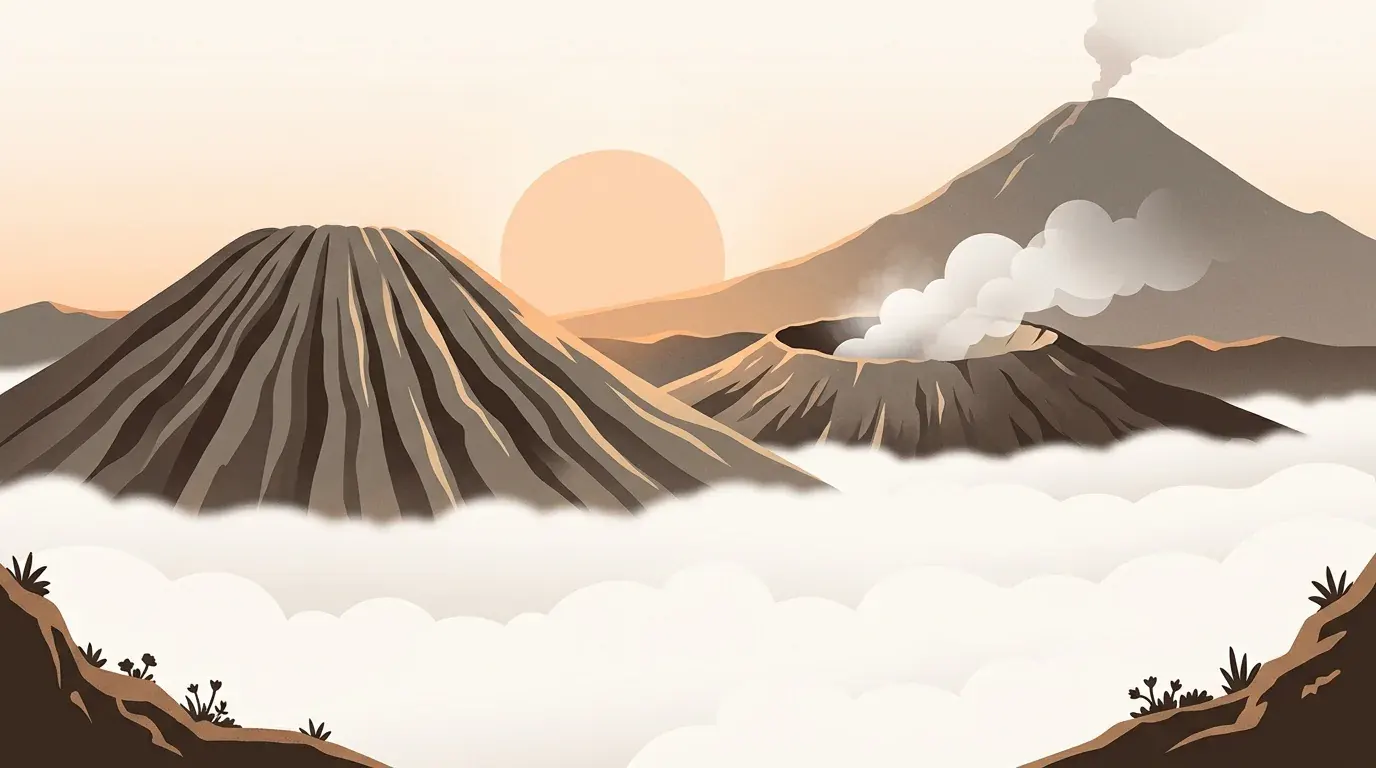
Illustration of the Tengger caldera: Bromo, Batok, and Semeru above a sea of clouds

Bromo is a mountain, a sacred place, and a home. This page covers where the name comes from, the legend, the history, and the life of the Tengger people, so your visit means more and stays respectful. We label folklore as folklore, and every fact has a source.

NAME

Where the words "Bromo" and "Tengger" come from.

Brahma → Bromo

The name Bromo comes from Brahma, the Hindu god of creation.[1][2] In Javanese pronunciation, the "a" in some syllables sounds close to "o", so Brahma sounds like Bromo.

Rara Anteng + Jaka Seger

According to folklore, "Tengger" joins the endings of two ancestors' names: Rara Anteng and Jaka Seger.[1]

LEGEND

The story of Rara Anteng and Jaka Seger, as told in folklore.

1

A couple below the mountain

Rara Anteng and Jaka Seger married and settled in the Tengger area, but for a long time they had no children.[1]

2

A promise to the gods

They meditated and made a vow: if they were given children, the youngest would be offered to the crater.[4]

3

The vow comes due

They were blessed with many children. When they tried to break the vow, the crater erupted and the youngest, Raden Kusuma, vanished into it.[1][3]

4

The child's message

He asked his siblings to bring offerings to the crater every year. This is the origin of Yadnya Kasada, the yearly Tengger offering ceremony.[1][4]

There are several versions. Sudiro and Raffles say 25 children. Indonesia.travel says 24 children, then a 25th who was offered. GNFI 2025 says 10 children, with the youngest named Sukma.[1][3][4][5]


Day 14

Yadnya Kasada is held on day 14 of Kasada, the 12th month of the Tengger calendar.[1][4]

Into the crater

Villagers bring crops and livestock and throw them into the crater as offerings.[4]

Pura Luhur Poten

The temple on the Sea of Sand where the ceremony takes place before the procession climbs to the crater. Built in 1996.[3]

HISTORY

Traces of Tengger in inscriptions and historical records.

929 CE

The Walandit inscription (851 Saka) mentions a sacred place in the Tengger mountains, home to the hulun hyang, servants of the gods.[3][1]

Majapahit era

Anthropologist Robert Hefner argues that the Tengger people carry on Javanese Hindu-Buddhist traditions, and some descend from Majapahit refugees. Pigeaud and De Graaf hold a different view.[6][3]

1973

Under the New Order government, the religion of the Tengger people was officially declared Hindu, with the involvement of PHDI (the Indonesian Hindu council). Today it is often called Hindu Tengger.[3]

1989 and 1996

The first temple was built in Ngadas (1989), followed by Pura Luhur Poten on the Sea of Sand (1996).[3]

1997 and 2005

The area was designated Bromo Tengger Semeru National Park (Forestry Ministry decree 278/Kpts-VI/1997), then formally set at 50,276.2 ha (decree 178/Menhut-II/2005).[11]

2015

UNESCO named the Bromo Tengger Semeru Arjuno Biosphere Reserve on 9 June 2015.[12]

TENGGER

The people who still live on the slopes of the caldera today.

4 regencies

Tengger land spreads across Probolinggo, Pasuruan, Malang, and Lumajang.[7]

36 villages

Mongabay counts 36 Tengger villages that still follow adat, customary law and tradition.[7]

Dukun pandita

Each village has a dukun pandita, a customary priest who leads ceremonies. Today they are organized in the Paruman Dukun Pandita council.[3]

Tengger has no castes or royal courts like Bali. Custom is kept by each village and its priest.[6] Residents follow different religions. In Ngadas, Malang, about 50% are Buddhist, 40% Muslim, and 10% Hindu, and all of them keep the shared customs. The Tengger call themselves Wong Tengger, the Tengger people.[7]

Yadnya Kasada

The yearly offering to the Bromo crater, in memory of Raden Kusuma's message.[4]

Karo

The main Tengger holiday, when neighbors visit each other's homes.[7]

Entas-entas

A ceremony to lay the spirits of deceased family members to rest.[7]

Unan-unan

Held every 4 or 5 years with a buffalo offering. In Wonokerso it is also called Mayu Bumi.[8]

Tengger people wear the sarong tied in different knots for different purposes. This source explains what the women's knots mean in Ranu Pani.[15]

LANDSCAPE

An ancient caldera, five cones, and the mountain of the gods.

± 16 km

The width of the Tengger caldera, left by an ancient volcano. Its floor is now the Sea of Sand.[9]

5 cones

Bromo, Batok, Kursi, Widodaren, and Watangan. Only Bromo is active.[9]

Mahameru

In the Tantu Panggelaran manuscript, the gods moved Mount Meru from India to Java. Its peak became Semeru.[10]

Bromoactive
Batokinactive
Kursiinactive
Widodareninactive
Watanganinactive
ETIQUETTE

Bromo is a sacred place. Here is how to show respect.

Closed during Kasada

In 2026 the area was closed to tourists from 30 May to 2 June, following a notice from the Paruman Dukun Pandita.[13]

Respect sacred areas

Pura Luhur Poten and the crater are ceremonial sites. Do not disturb people at prayer, and follow what locals ask.[4]

Customary penalties apply

Paragliding and flying model aircraft are banned in the sacred area. Violators can face customary sanctions.[14]

See the safety rules